
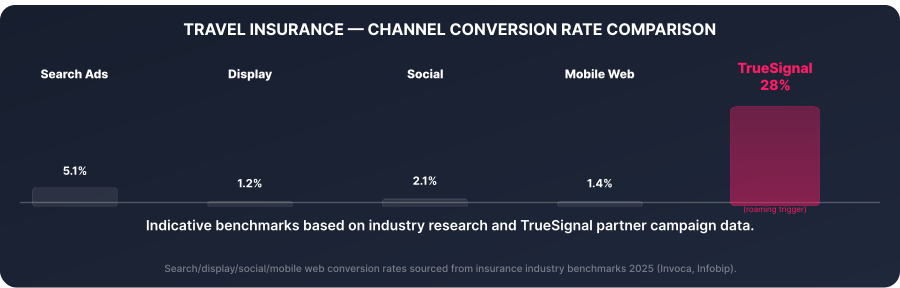
Travel insurance has a timing problem that no amount of programmatic optimisation can solve. Target consumers too early, weeks before a trip, and they haven’t committed. The trip might not happen, the destination might change, or another insurer will intercept them closer to departure. Target them too late, the morning of a flight, and they’ve already sorted cover. Or the booking window has closed. The digital marketing industry’s response has been frequency: blast broadly across search and social, hoping to land in the right window. The result is one of the most expensive CPLs in the insurance category. Average search-ad conversion rates are just 5.1% across all insurance verticals. Travel-specific website conversion sits between 1.4% on mobile and 3.9% on desktop. The timing problem isn’t solved by volume. It’s solved by signal.
“The moment a subscriber activates international roaming, they have made a decision. They are travelling. That window is 100% verified and closes the moment the plane lands.”
Travel Insurance: TrueSignal’s Approach
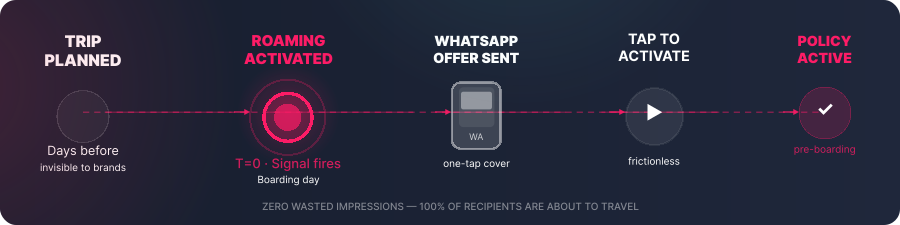
TrueSignal’s approach is structurally different. The roaming activation event is the moment a subscriber’s SIM connects to an international carrier network. It is a deterministic, real-time network signal with a precise meaning. This person is about to travel internationally, or has just arrived at a foreign destination. They have made a financial commitment to travel. They are definitionally a travel insurance prospect. This signal comes entirely from network service activation data, with no message content, no communication metadata, and no app scanning. Every single recipient of a TrueSignal roaming-triggered campaign is, by definition, a traveller at that exact moment. A WhatsApp one-tap offer lands in a moment of high receptivity. It shows the destination country, a single flat rate, and a buy button, when the subscriber has travel top of mind and a strong reason to act.
The Economics of Roaming Segmentation
The economics are compelling when set against the standard alternative. Travel insurance is among the highest-CPL categories in digital media. Comparison shopping engines charge insurers £18–£40 per qualified lead in the UK market. And they do so where the consumer is simultaneously comparing five or more competing offers. A TrueSignal roaming-triggered WhatsApp campaign inverts this dynamic entirely: no comparison engine, no competing message, no delay. In a 2025 partner campaign across a Southeast Asian MNO network, a single-send WhatsApp campaign delivered a 28% conversion rate. That came against a CPL approximately 73% below the insurer’s prior search spend. Because every recipient was a verified traveller, not a single impression was wasted.
For travel insurers and their media agencies, this is a structural reorientation of acquisition strategy. The comparison engine is not a distribution partner. It is a margin compressor, extracting value from every policy sold while building the competitor’s brand alongside yours. A direct-to-subscriber campaign via TrueSignal eliminates that intermediary entirely. The brand speaks first, in a personal channel, at the only moment that matters. The travel insurance market continues to grow, with global travel insurance projected to reach $40.5 billion by 2029. In that context, brands that establish direct relationships at the point of genuine intent will compound the advantage across repeat travellers and renewals. The roaming signal is not just a performance lever. It is a customer acquisition infrastructure that comparison engines cannot replicate.
SOURCES
- ↗ Invoca / Infobip Travel Insurance mobile conversion research 2025
- ↗ GSMA Intelligence roaming data usage statistics
- ↗ Swiss Re / Munich Re travel insurance market digital research
- ↗ WhatsApp Business “State of Business Messaging” report