What Commercial Intent in theNetwork Actually Means
Audience segmentation was the first serious attempt to bring discipline to advertising targeting. Demographic filters, interest categories, lookalike models — each was an improvement on spray-and-pray reach buying. But the model has a structural ceiling it has never escaped: it optimises for who someone resembles, not for where they are in a purchase decision. An audience segment labelled “travel intender” might be 2.2 million people who have visited a travel site in the past 90 days. A meaningful fraction of them have already booked. Another fraction are browsing idly. A third has not thought about travel in weeks. The segment is real. The intent is assumed. Research tracking segment decay consistently finds that behavioural audience data loses 40–60% of its predictive accuracy within a month of collection — and most media plans run on data older than that.
“Timing is the most undervalued variable in media planning. The same message to the same person can be irrelevant on Tuesday and decisive on Thursday.”
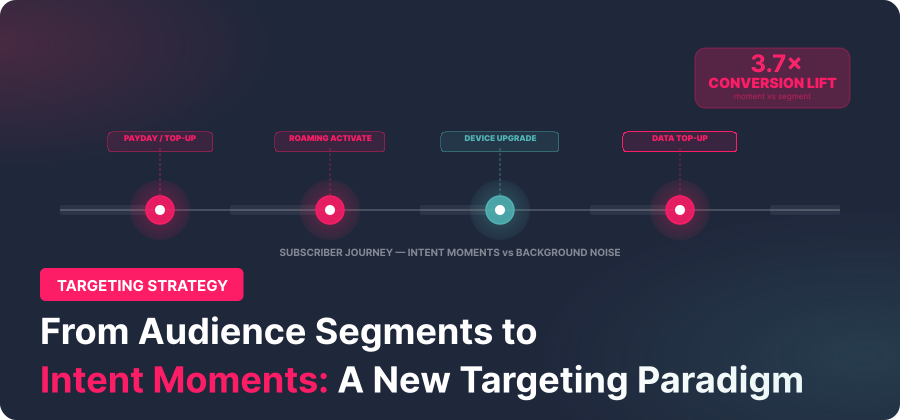
The intent moment framework begins from a different premise: that commercial readiness is a state, not a trait. It is not something a person permanently is; it is something they temporarily enter. A subscriber who tops up their mobile balance on the 28th of the month has entered a liquidity state. A subscriber who activates international roaming is in a travel preparation state. A subscriber whose handset contract enters its 22nd month is in a device-consideration state. Each of these moments has a duration — measured in hours to days, not weeks. Each correlates with a distinct category of purchasing behaviour. And each is detectable in real time through the mobile network, before the subscriber has expressed any interest on the open web. Where a traditional segment asks “who might buy?”, an intent moment asks “who is ready to buy right now, and for exactly how long?”

The compounding effect of combining signal freshness with intent strength is significant. Intent-qualified audiences consistently deliver higher conversion rates — not because the creative is different, but because the ad reaches a subscriber who is already in a receptive state. Across TrueSignal partner deployments, moment-triggered campaigns have recorded conversion lifts of 3.1–3.7× versus demographically equivalent segment-based campaigns targeting the same product categories. The variable that accounts for most of that gap is not audience size, creative format, or bid strategy. It is timing. For brands and agencies, the practical shift is to restructure briefs away from audience personas and toward activation triggers: define the subscriber behaviour that signals readiness, specify the window within which the message must land, and let TrueSignal’s network-layer detection handle the rest. Segments describe who people are. Moments describe when they are ready.

The shift from segment to moment does not require abandoning audience strategy — it requires adding a temporal layer to it. The right person, reached at the wrong time, is still a missed conversion. TrueSignal’s planning framework layers intent moment detection on top of existing audience profiles, ensuring that demographic and behavioural targeting criteria are applied at the precise moment when a subscriber’s network behaviour confirms purchasing readiness. For brands already investing in high-quality audience data, this is not a replacement strategy. It is the activation mechanism that transforms audience knowledge into conversion performance — delivering messages not just to the right people, but at the exact window when those people are most likely to act.
SOURCES
↗ McKinsey & Company — “Moment Marketing and the Consumer Decision Journey”, 2023
↗ Think with Google — “Micro-Moments: Your Guide to Winning the Shift to Mobile”, 2022–2024
↗ Salesforce — State of Marketing Report, 8th Edition, 2025
↗ Segment / Twilio — Audience Data Decay and Real-Time Personalisation Research, 2024