
Every programmatic campaign carries a hidden timestamp, the age of the data inside the audience segment. By the time a brand’s creative reaches a user, the signal that qualified that person for the segment may be 6, 24, or 72 hours old. That delay is not a technical inconvenience. It is a structural gap between the moment a person exhibits commercial intent and the moment an ad is served against it. Stale audience data does not just reduce efficiency, it inverts the premise of intent-based targeting entirely. You are no longer reaching someone at the moment of readiness; you are reaching them after that moment has passed, at best, or after they have already converted elsewhere, at worst.
How the Programmatic Pipeline Delays Every Signal
The data pipeline problem is baked into the architecture of programmatic advertising. A consumer visits a product page, triggering a cookie. A DMP ingests that event in a batch cycle, typically every 10 to 30 minutes, sometimes longer. A sync schedule that may run once every 24 hours then exports the resulting segment to a DSP. By the time that segment is active and bidding, the underlying intent signal is already old.
Google Ads documentation acknowledges that data segments can take 24–48 hours to populate. Industry analysts describe weekly or monthly delivery cadences for identity refreshes across programmatic systems. A brand targets the Monday travel-site browser on Wednesday. By then, the consumer may have already booked, lost interest, or converted with a faster competitor. TrueSignal bypasses this pipeline entirely. A network event (a top-up, a data spike, an upgrade cycle trigger) matches to an active campaign brief and delivers in under five minutes.
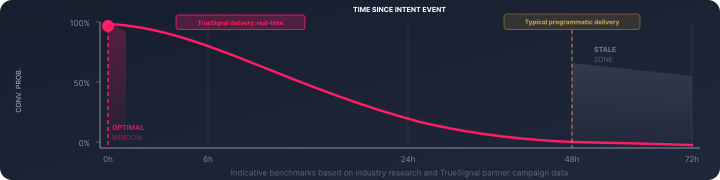
Intent data has a half-life measured in days, not weeks and vendors who act on signals within 48 hours see conversion rates 4× higher than those who wait.
The 4× Conversion Gap: Fresh Signals vs. Stale Audience Data
The commercial consequence is measurable. Research consistently shows that intent signal decay is rapid and nonlinear. A person who topped up their prepaid balance two hours ago is a fundamentally different prospect than someone whose last relevant event was 48 hours prior.
The conversion window on high-intent moments is narrow. Industry data from intent data providers indicates a clear pattern. Acting on a Tier 1 signal within 48 hours yields conversion rates roughly 4× higher than delayed engagement. For categories like financial services, travel, and consumer electronics where buyers make purchase decisions within short windows, the cost of stale data is not marginal. It is the difference between being present at the decision moment and arriving after it has closed. Brands buying programmatic audience segments are, structurally, always buying the past.
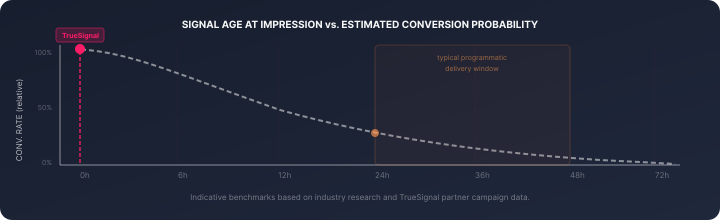
For CMOs and heads of media, this is a structural argument not a feature comparison. The question is not whether a programmatic platform has real-time bidding capability (most do). The question is: how old is the underlying signal that determines who gets bid on? RTB operates in milliseconds. The audience data feeding it may be days old. TrueSignal’s value is not that it bids faster, it is that the signal triggering delivery is happening right now, to a verified human, on a device tied to a real contractual identity. Brands that shift budget toward real-time telco-triggered delivery are not just buying a more efficient channel; they are buying access to intent at the moment it exists, rather than a historical record of it.
SOURCES
- ↗ Salesforce / Segment — “State of Marketing Data” and Signal Latency Research; audience data decay benchmarks (2023–2024)
- ↗ eMarketer — “Programmatic Data Pipeline Latency and Segment Freshness” studies; DMP-to-DSP sync window analysis (2024)
- ↗ Bombora / TechTarget — Intent Data Signal Freshness Research; conversion rate lift for signals acted on within 48 hours vs. delayed engagement (2023–2024)
- ↗ IAB / OpenRTB — Real-Time Bidding latency statistics and audience data staleness benchmarks; Google Ads documentation on data segment population delays of 24–48 hours