
Quick-service restaurants occupy an unusual position in the media landscape, and QSR marketing has struggled to adapt. Purchase frequency is extremely high. The average QSR customer visits multiple times per week. But purchase intent is hyper-perishable. Lunch intent exists for roughly 90 minutes, not 90 hours. A consumer thinking about where to eat at 12:07pm is not weighing the same decision at 2:30pm. Standard programmatic targeting is built on cookies, browsing history, and demographic inference. It is structurally ill-suited for this dynamic. It serves ads to people who ate at a competitor last Tuesday, not people who are within 400 metres of a location right now.
The result is the familiar gap between campaign delivery metrics and redemption performance. Research confirms that QSR location-based campaigns without real-time proximity generate click-through rates roughly half those of proximity-aware campaigns, 0.61% versus 1.21%. The problem is not the format or the offer. It is the distance between the ad and the decision moment.
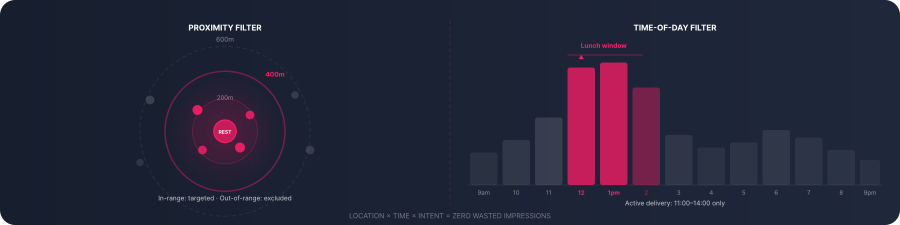
Lunch intent does not wait for the afternoon reporting run. If the offer lands at 12:07pm, within 400 metres, it lands into a live decision. At 2:30pm it is archived.
The Two Signals Behind Precise QSR Marketing
TrueSignal’s QSR solution combines two deterministic signals. The first is network-level location data, the subscriber’s physical proximity to a specific restaurant, verified by cell tower and antenna triangulation. The second is time-of-day filtering, so the offer fires only within the defined lunch or dinner window. The combination produces a targeting condition that is both spatially and temporally precise. It is derived entirely from network usage patterns and device location signals, with no access to message content or app activity.
A Visual SMS message with a branded image, a specific offer, and a one-tap map link reaches only subscribers close enough to act on it. It arrives during a window when lunch intent is definitionally active. There is no wasted delivery to someone across town, or to someone who already ate, or to someone who won’t pass until evening. Every impression is a live prospect.
The Redemption Gap That Reshapes QSR Marketing
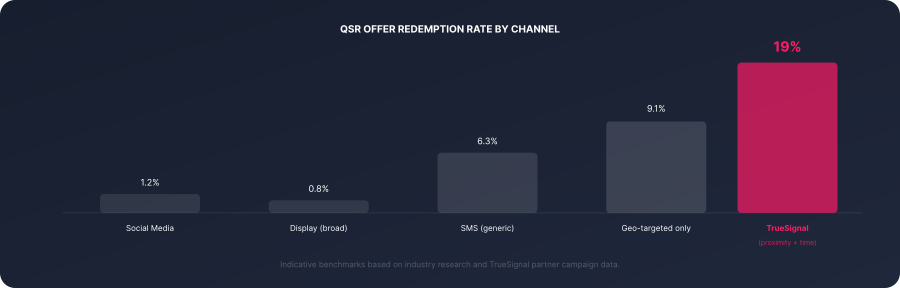
The redemption rate differential illustrates the gap clearly. In a 2025 QSR campaign across a major Southeast Asian urban market, TrueSignal proximity-intent Visual SMS delivered a 19% redemption rate. The same lunchtime offer achieved just 1.2% via social media targeting. That is not a marginal improvement. It is a 15 times gap that flows directly into cost-per-redemption economics. The average QSR incremental basket value for a promoted item is $6 to $9. So the cost-per-redemption math rapidly becomes compelling.
A campaign driving genuine foot traffic at 19% redemption operates at a fraction of the CPA of a social campaign that reaches the right demographic at the wrong place and time.
The broader implication is a shift in the planning question. It moves from “how do we reach our demographic?” to “how do we reach our demographic, within walking distance, during a meal window?” The location-time intersection is where QSR performance lives.
Scaling Neighbourhood Precision Across Every Outlet
For QSR marketing teams managing a network of locations, scalability matters just as much. TrueSignal’s platform allows location-level targeting across all outlets simultaneously. Each restaurant’s geofence triggers independently against the same campaign brief. A national fast-food chain running a lunchtime promotion activates the signal across every city location at once. Each one fires only when a verified subscriber enters the proximity radius during the defined window.
The operational result is a campaign that scales nationally while executing at the precision of a neighbourhood handshake. Frequency management ensures no subscriber receives more than one offer per session, protecting brand experience. Cost-per-redemption, tracked against footfall data, consistently outperforms every broadcast alternative. For brands whose distribution density turns proximity into an asset, TrueSignal turns that proximity into measurable, attributable revenue.
SOURCES
- ↗ Marketing Dive / QSR Web mobile coupon redemption statistics 2025
- ↗ Unacast “Three Ways to Use Location Data in Digital Advertising”
- ↗ Near Intelligence proximity marketing effectiveness research
- ↗ National Restaurant Association mobile marketing report