
The ad verification industry has a structural problem that no one wants to name clearly. IAS, DoubleVerify, and MOAT all operate after the impression has been served. Their tags fire, their reports generate, and their dashboards surface invalidity metrics. All of this happens after money has already moved. The MRC standard, which these tools are built to satisfy, mandates post-bid measurement and filtration. That is not a limitation of implementation. It is the architecture of the category. A class action filed against DoubleVerify in May 2025 alleged systematic bot detection failures. In the same period, the open exchange recorded a 101% year-over-year surge in bot fraud. The verification tools were present. They were measuring. The fraud still grew.
Post-delivery fraud reporting is not a safeguard. It is a damage report issued after the fact.
Why Pre-Delivery Selection Beats Post-Delivery Detection
Supply path optimisation is now actively implemented by 87% of brands, agencies, and DSPs, according to IAB Europe. It represents the industry’s first serious attempt at structural intervention. The ANA’s 2023 study found that 15% of programmatic spend flowed to made-for-advertising websites. By Q1 2025, that figure had dropped to 0.4%. SPO works because it removes weak supply paths before impressions are bought. The lesson is unambiguous: pre-delivery selection outperforms post-delivery detection every time. Yet agencies still purchase open exchange inventory and rely on tag-based tools to tell them what went wrong. They do this rather than building delivery infrastructure that eliminates the problem upstream.
From Auditing What Happened to Controlling What’s Possible
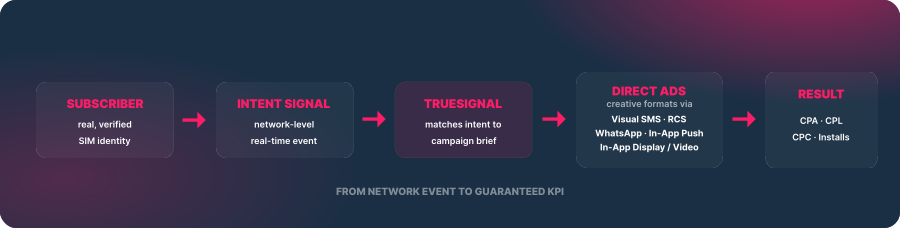
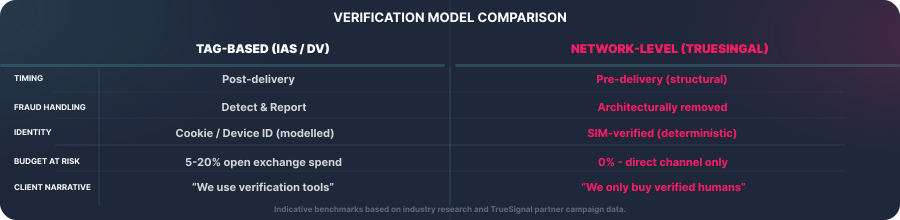
Network-level delivery is not a better version of tag-based verification. It is a different category of problem-solving. When TrueSignal routes a campaign through MNO infrastructure, the subscriber identity is confirmed at the SIM level. This is a contractual, real-world identity that no bot can replicate. There is no tag to fire after the fact, because there is no fraud pathway available before delivery. The ad goes to a verified human on a verified device, through a direct channel with no open exchange intermediaries. For agencies, this is the shift from auditing what happened to controlling what is possible. It also changes the client conversation. Instead of reporting on fraud rates, agencies can report that structural fraud was architecturally eliminated. No IAS or DoubleVerify tag can credibly claim that position.
A Guaranteed-Human Layer in the Channel Mix
For media agencies building quality baselines into their planning, TrueSignal functions as a guaranteed-human layer in the channel mix. Programmatic activity remains necessary for scale. Alongside it, a TrueSignal allocation provides a verified floor. Every impression in that portion of the plan reached a confirmed subscriber, not a modelled audience or probabilistic segment. The strategic value to agencies is twofold: better performance outcomes for clients and a materially stronger compliance and brand-safety narrative. Procurement teams and CMOs are beginning to scrutinise verification claims more carefully. The May 2025 congressional enquiry into IAS and DoubleVerify suggests this scrutiny is accelerating. The agencies that have already moved to structural fraud prevention will be the ones with nothing to explain.
SOURCES
- ↗ ANA (Association of National Advertisers) — Programmatic Transparency Report 2023/2024: 15% of open exchange impressions flowing to MFA inventory (2023 peak); subsequent reduction through blocklist efforts
- ↗ IAS (Integral Ad Science) — Programmatic verification methodology documentation: MRC standard post-bid measurement and filtration architecture
- ↗ DoubleVerify — Class action filing and verification limitations press coverage (May 2025): 101% YoY surge in bot fraud; congressional scrutiny of verification tool limitations
- ↗ eMarketer — “5 Key Stats on Ad Waste: Fraud, MFAs, Brand Risks” 2025: Q2 2025 MFA spend estimated at $770 million globally
- ↗ IAB Europe — Supply Path Optimisation Research 2025: 87% of brands, agencies, and DSPs now actively implementing SPO; structural fraud prevention outcomes