
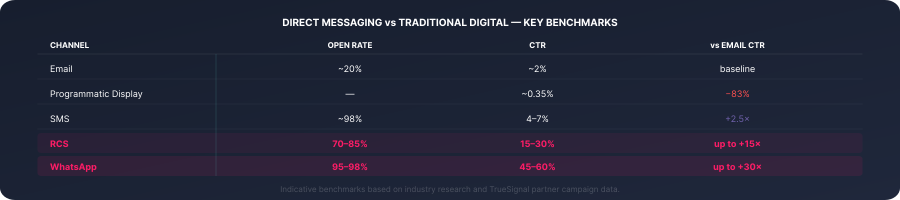
The performance data for direct messaging channels has been unambiguous for years. WhatsApp delivers open rates of 95 to 98%, a 4.6× improvement over email. Its click-through rates run 45 to 60% in commercial messaging deployments. RCS campaigns record read rates of 70 to 85% and CTRs of 15 to 30%. They also show a 20% average conversion uplift over traditional SMS. The RCS market grew from $2.87 billion in 2025. It is forecast to reach $10.93 billion by 2031, at a compound annual growth rate of 24.95%. These are not niche figures from small-scale pilots. They represent category-level structural performance that is reproducible and documented. Yet for most brands, this performance is entirely absent from media plans. The question is not whether these channels perform. It is why the industry continues to overlook them.
A 45% CTR and a 97% open rate are not benchmarks to aspire to. They are the baseline that direct messaging channels routinely deliver.
Why Direct Messaging Delivers Where Other Channels Don’t
The structural reason for this performance gap is direct delivery. Email sits in an inbox competing with hundreds of other messages. Algorithms filter it, and it renders in a context designed for scanning rather than engaging. Social display competes inside algorithmically curated feeds. There, brands share attention with friends, news, and content built to be compelling. RCS and WhatsApp arrive in a conversation context. It is the part of the device users associate with people they trust, not advertising they filter. There is no feed competition, no algorithmic gating, no viewability question. The message arrives. It is seen.
According to Infobip’s 2026 benchmark data, 90% of RCS rich media messages are opened within 15 minutes. This is not engagement that creative optimisation can buy in other channels. It is a structural property of the delivery medium itself. WhatsApp’s 200 million active business accounts and RCS’s 50 billion messages sent in 2025 confirm the point. This is not an emerging channel. It is a mature, scaled infrastructure that brands systematically fail to use.
The Creative Advantage of RCS and WhatsApp
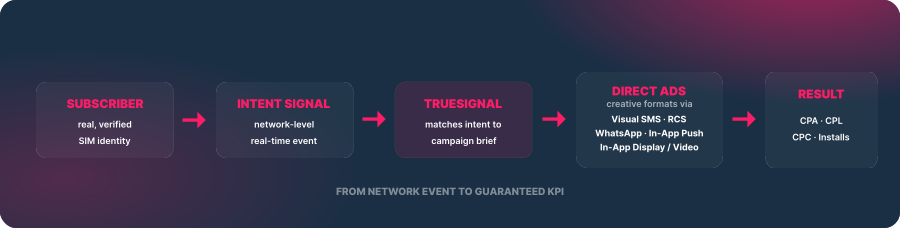
RCS adds a creative dimension that closes the remaining gap between messaging and display formats. Branded cards with carousels, inline CTAs, rich imagery, and video give brands a real visual canvas. They pair it with the delivery certainty of SMS. Brands like Clarins have recorded 7× higher conversions on WhatsApp versus comparable email deployments. D2C brands consistently report CTRs of 80% on WhatsApp versus 5% on email for the same offer. The creative advantage is real. But it operates downstream of a more fundamental structural property. The message arrives in full, undiluted by feed competition, to a person who opted into the channel as part of their daily habit. TrueSignal’s role is to layer verified commercial intent on top of this structural engagement advantage.
The subscriber receiving the RCS carousel or WhatsApp message is not simply reachable, but demonstrably ready. Right channel, right person, right moment: that is what makes direct messaging through TrueSignal structurally different from any other format.
Why Media Plans Still Overlook Direct Messaging
The underinvestment in direct messaging is not a mystery. It is a planning habit. These channels do not appear natively in DSP interfaces. They are not included in standard reach-and-frequency tools. They require relationships with MNO infrastructure partners, not a few clicks in a self-serve platform. But for brands willing to make that connection, the performance differential is significant. It warrants treating direct messaging not as a supplementary channel, but as a primary one. TrueSignal qualifies a subscriber with a real-time intent signal, derived from network usage patterns, service activation events, and device behaviour. It then delivers a branded RCS message to that subscriber’s device within minutes.
The response rates reflect something programmatic optimisation cannot replicate: genuine readiness, delivered at the moment it exists. That is what the engagement data is measuring. And it is why the gap between direct messaging and every other channel is not closing.
SOURCES
- ↗ Infobip “Key RCS Statistics & Market Insights 2026”
- ↗ CM.com “RCS Statistics for Marketers”
- ↗ MessageFlow “Top 15 RCS Statistics 2025”
- ↗ Wapikit “WhatsApp Business Statistics 2025: 3.2B Users, 98% Open Rates”
- ↗ Juniper Research RCS Business Messaging traffic forecast 2025
- ↗ Attentive SMS vs RCS comparison research