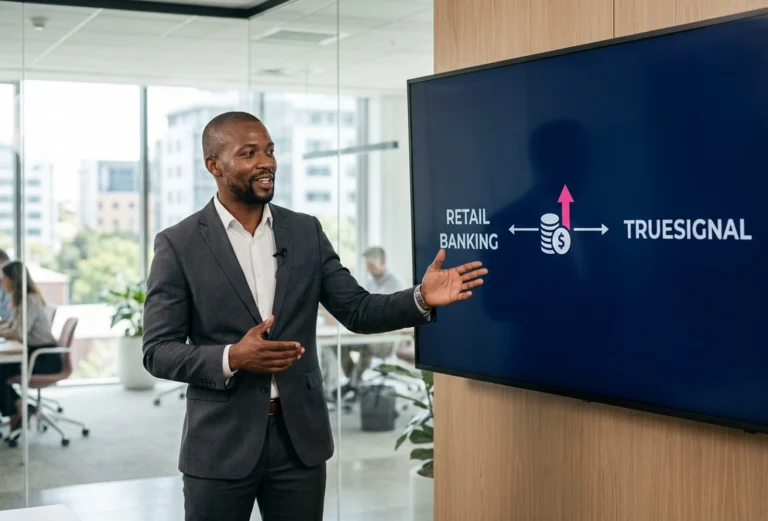
I will take a typical brief and follow it all the way through, to show what a customer acquisition campaign on telco channels looks like in practice. A bank wants 2,000 new accounts for a premium product, in Romania, within 30 days. Primary KPI: cost per account opened. Secondary KPI: activation rate within the first 14 days.
When the signal points to a real buying window, you stop paying for impressions and start investing in results.
Step 1: Define the Result in a Single Sentence
Objectives that mix awareness, engagement, traffic and sales with no hierarchy end badly. Choose the main action: new accounts, first deposits, app installs, eligible leads, store visits, test drive bookings. Everything else is a supporting metric.
Step 2: Describe the Ideal Customer Through Signals
For the bank in our example: a segment with recurring financial activity and signals of recent comparison in the financial category. It would be purchase frequency, category and mobility for a retailer. For automotive, signals from the car category and geo-presence in the relevant retail areas.
Step 3: The Segment and the Trigger Decision
Some campaigns run on stable segments, while others gain from a recent event. Here we went with Competitor Switcher, using a trigger based on recent comparison in the financial category. The profile narrows the audience, and the trigger picks the window. Before launch, we estimated the segment size. We also ensured it remained above the 30,000-to-50,000-user threshold. Below this threshold, a campaign has nothing to teach you.
Step 4: An Offer Written for the Context
This is where many campaigns throw away the advantage of targeting: they use a sophisticated audience and deliver the same generic creative they run everywhere else. For a segment in the comparison phase, the message has to address the barrier to switching: how long it takes, what it costs, what happens to the old product. The segment’s context should be visible in the message.
Step 5: Choose the Format by the Action
The campaign started with VMS for the first touchpoint, continued with Push+ as a reminder during the comparison window, and used the voice agent to qualify those who responded, followed immediately by an SMS. The creative, including training the voice agent, was produced by our team and included in the service.
Step 6: A Performance-Based Commercial Model Aligned With the KPI
Our main model is performance-based: cost per action, per lead or per click. CPM is used only in exceptional cases, for In-App in awareness campaigns. The voice component is billed only per lead or per acquisition, with no charge per call made. Before launch, we agree together on what counts as a qualified lead, what the conversion window is and how conversions are attributed, so that at the end there is a single set of numbers.
If a client mainly wants awareness and buys on CPM, I tell them openly that they will find cheaper options elsewhere. We deliver results.
Step 7: Agree on What Success Means From the Start
Alongside the primary KPI, select two or three metrics to explain performance. These include conversion rate, cost per action, lead quality, retention and sales. For an app install campaign, cost per install alone is misleading. An install only counts if the user remains active.
Reporting happens in real time, based on aggregated data: how many messages were delivered through each format, how interactions are developing in each segment and how cost per action is moving. This means the campaign can be optimised while it runs, as well as analysed once it ends.
How We Work With Agencies
TrueSignal is a service we manage. The agency brings the brief and the ideal customer profile. We build segments from the brief within the operator’s environment. We size and activate them, recommend the format and pricing model, and produce the creative. The agency keeps ownership of the strategy, the messaging and final approval, without having to operate a new platform.
A self-serve model will follow later, once the market understands signal logic and segment creation.
From signed brief to first delivered message usually takes a matter of hours. The creative effort is small compared with classic digital. You need a short text, a visual and a clean landing page. Classic digital would require ten formats for ten placements.
The budget question usually comes up early. What matters is how many eligible users the segment has and whether the volume is large enough to learn something from the campaign. That conversation happens at the brief stage, before anything is spent.
Where We Stand in Romania
In Romania, through our partnership with the local operator, we cover approximately 40% of subscribers eligible for marketing communications. Data and identifiers stay within the operator’s controlled environment, while we bring the technology, the ad operations team, brand demand and the commercial model.
Operators across Latin America, the Gulf, the Middle East and Asia-Pacific already use or are implementing the same model. This supports advertisers across several markets through the same taxonomy, the same formats and one contract.
What Comes Next Over the Next Two to Three Years
We are looking at four directions: multi-operator coverage, moving towards majority coverage in our target markets; a self-serve platform for small businesses and agencies; integration with programmatic buying; and expanding the voice component, where the greatest value at the bottom of the funnel is concentrated.
To brands that work exclusively with classic digital channels I always say the same thing: social, video and display are very good at building awareness and are worth keeping. What they lack is the other half: verified people, a real moment of intent and paying for what happens after the click. That is where the advantage lies, and it shows up in the cost of acquisition.
This is where the series comes full circle. A quality audience tells you that you are talking to real people. Signals show where the potential is. Timing finds the window. The format makes the message visible. The commercial model ties everything back to the result.
Contact us to set up a TrueSignal campaign for your company or for your agency’s clients.