
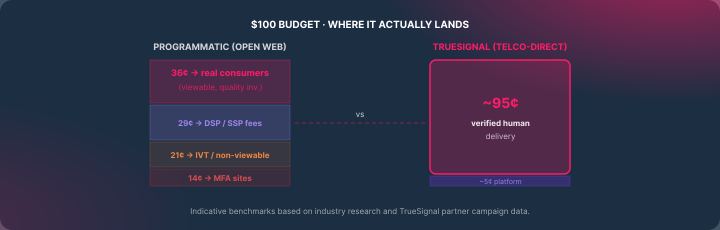
In 2025, global losses to ad fraud are projected to reach $41.4 billion. This figure has grown consistently year over year and shows no sign of structural reversal. But headline fraud numbers actually understate the problem. The more precise issue is not just fraud in the narrow sense of bots and click farms. It is the entire architecture of programmatic waste. The Association of National Advertisers (ANA) examined the programmatic supply chain in granular detail. They found that only 36 cents of every dollar entering a DSP reaches a consumer as a viewable impression on quality inventory. A more recent 2024 benchmark puts this figure at 43.9 cents. That is an improvement, but still a loss rate no other media channel would tolerate.
Three distinct drains absorb the remaining budget. First, intermediary fees: DSP and SSP take rates consume roughly 29 cents of every dollar. Second, invalid traffic and non-viewable impressions (~21%). Third, Made-for-Advertising sites built specifically to harvest ad spend without delivering a real audience.
Fraud persists not because verification tools are inadequate. It persists because the programmatic model has no identity check at the impression level.
Why Programmatic Can’t See Who’s on the Other End of the Bid
The structural reason this problem endures is that programmatic advertising is identity-blind at the point of delivery. A DSP bids on an impression defined by browser signals, device IDs, and probabilistic audience data. It has no direct visibility into whether the end recipient is a human being or a data-centre server generating artificial traffic. Verification tools from IAS and DoubleVerify are retrospective. They audit traffic after advertisers have committed spend and flag suspicious patterns after the fact. They do not stop the exchange from placing the bid or counting the impression. In Q1 2025, Pixalate measured US web invalid traffic rates at 21% and mobile app IVT at 26%.
On MFA sites specifically, IVT rates run nearly 6× higher than on non-MFA inventory. Certain programmatic networks record fraud rates exceeding 46%. These are not edge cases. They are the median operating environment of open web programmatic advertising.
The Zero-Fraud Model Built Into Every Telco-Direct Campaign
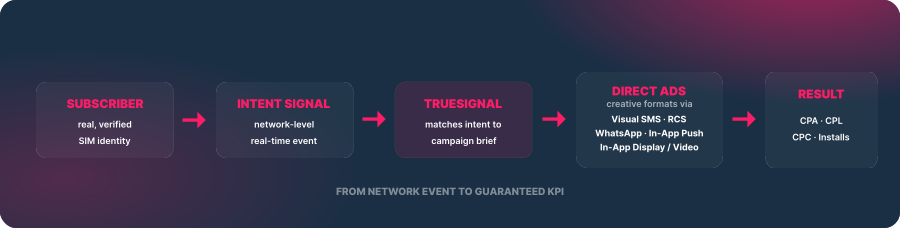
Telco-delivered campaigns are structurally immune to these losses not through better verification tooling, but because the model eliminates the conditions that enable fraud. An MNO’s network infrastructure delivers a message to a SIM-registered subscriber: a real contractual identity, verified through KYC at sign-up, tied to a physical address and a payment relationship with the network. No one bids on an anonymous impression slot. There is no exchange inserting inventory from unverified publishers. The intermediary fee stack collapses: there is no DSP take rate, no SSP margin, no exchange fee.
Budget flows from advertiser to verified human with minimal friction. For brands currently running programmatic budgets at scale, even a modest reallocation toward telco-direct channels produces an immediate working media efficiency gain not because the targeting is slightly better, but because the fundamental fraud tax simply does not apply.
From Fraud Detection to Fraud-Proof Architecture
The practical implication for brand and agency media teams is that the fraud conversation needs to shift from detection to architecture. Verification tags, pre-bid filtering, and inclusion lists are all additive costs layered onto a system that generates waste structurally. The more effective solution is to route a greater share of budget through channels where fraud cannot exist at the impression level because the end recipient is a contractually verified subscriber, not an anonymous cookie in an open exchange. This does not mean abandoning programmatic entirely.
It means holding programmatic budgets to a higher accountability standard, and allocating a growing share of performance media investment to channels where every cent of budget maps to a real, identifiable, in-market person.
SOURCES
- ↗ Statista / eMarketer — “Global Cost of Digital Ad Fraud 2025”: $41.4 billion projected global fraud loss (2025)
- ↗ ANA (Association of National Advertisers) — Programmatic Media Supply Chain Transparency Study (2023 baseline, updated 2024): 36¢ of every programmatic dollar reaching real consumers; 43.9¢ in 2024 benchmark
- ↗ Pixalate — Q1–Q3 2025 Global Ad Fraud Benchmarks Reports: 21% web IVT rate, 26% mobile app IVT rate, MFA IVT rates ~6× non-MFA average
- ↗ NEXD / SpiderAF — Ad Fraud Statistics 2025: programmatic network fraud rates exceeding 46% in certain environments
- ↗ Runner Media — “$26.8 Billion in Ad Spend Was Lost to Ad Fraud” analysis: US open web programmatic waste quantification