
Outcome-Driven Advertising: Selling Results, Not a Channel
Outcome-driven advertising starts here: when you know who’s ready to buy, you stop paying for impressions and start investing in outcomes.
Stat callouts
- −54% Cost Per Action (vs programmatic avg)
- 3.8× Leads Quality (intent-verified CPL)
- −61% Cost Per Click (signal-qualified traffic)
- 2× App Retention (Day-30 vs meta installs)
Intent signals
recharge event · salary credit · roaming on · app install · data spike · upgrade cycle
For most brands, a media plan is a list of channels: display, social, search, video. Each promises reach; none guarantees results. Spend is committed upfront. Outcomes are rationalised after the fact. This is the structural problem with channel-first advertising — when the signals used to target audiences are probabilistic, inferred, or built on stale data, performance can only ever be optimised in hindsight. By the time a campaign “learns,” much of the budget is already spent against the wrong people.
“The question changes from who might buy? to who is ready to buy, right now?”
TrueSignal operates from a different starting point. Our data layer lives inside mobile network infrastructure — which means we see real-time, verified signals that reveal commercial intent before a consumer ever opens a browser. A subscriber topping up their balance, activating roaming, hitting a data ceiling, or entering a device-upgrade cycle is not an audience segment — it’s a person at a specific, identifiable moment of readiness. These are deterministic signals: tied to a real contracted identity, not modelled from browsing patterns.
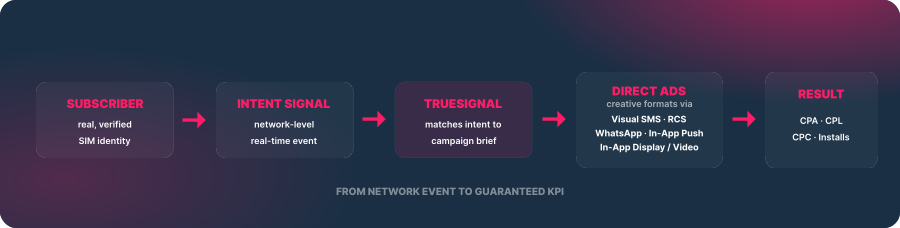
Outcome-Driven Advertising: From Network Event to Guaranteed KPI
Because intent is qualified before the message is sent, every downstream KPI improves structurally — not through post-campaign optimisation, but through audience quality. Cost-per-click falls because clicks come from people already leaning toward a decision. Cost-per-lead drops because leads self-qualify against real intent. App installs carry higher Day-30 retention because targeting selects for behavioural fit. Across campaigns in TrueSignal’s telco partner network, brands have consistently recorded CPA reductions of 40–60% versus equivalent programmatic spend — not because the creative was better, but because every recipient was a real, verified, in-market person.

For brands and agencies, this changes the brief entirely. Instead of negotiating formats, placements, and reach guarantees, the conversation becomes: what outcome do you need, and at what cost per result? TrueSignal’s outcome-based model enables performance commitments — against CPA, CPL, app install, or subscription activation targets — that are only possible when the underlying signal quality is this precise. The channel is a delivery mechanism. The format earns attention. But the result is what you’re actually buying.
SOURCES
- ANA (Association of National Advertisers) — Programmatic Media Supply Chain Transparency Study, 2023
- Wapikit — WhatsApp Business Statistics and Usage Report, 2025
- IAB (Interactive Advertising Bureau) — Signal Loss Report: Implications for Audience Targeting, 2024