
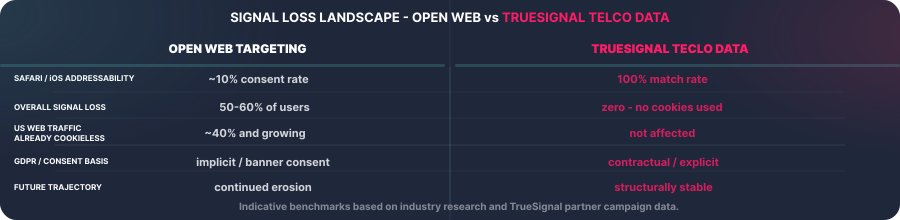
The advertising industry’s attention to cookie deprecation has focused predominantly on Chrome, the browser Google has repeatedly delayed committing to a concrete timeline on. That focus has obscured a more immediate reality: the cookieless transition is not a future event. It is already the dominant condition on a substantial portion of the web. Safari and Firefox have blocked third-party cookies by default for years. Apple’s App Tracking Transparency framework, introduced in 2021, has driven iOS ad tracking consent rates from an estimated 70% to approximately 10%.
The IAB estimates that these existing restrictions have already rendered 50–60% of internet users effectively unreachable through conventional cookie-based targeting. Roughly 40% of US web traffic already comes from browsers that block third-party cookies by default. Brands waiting for a Chrome deadline to act on signal loss are five years behind the curve.
The Privacy Advantage of Telco Data
Telco first-party data is structurally immune to the signal loss dynamics hollowing out programmatic reach. Mobile network operators hold subscriber relationships that are contractual, consented, and governed by strict regulatory frameworks: GDPR, the ePrivacy Directive, and national telecommunications regulations. Operators obtain consent for data use at the point of service agreement, making it explicit rather than implicit. Ongoing billing relationships renew that consent. There is no inference, no cross-site tracking, no fingerprinting.
The subscriber identity is real. The consent is documented. A regulated entity holds the data, subject to some of the most stringent data governance obligations in any industry. For brands building a cookieless strategy, telco data does not represent an alternative to privacy compliance. It represents the highest standard of it.
Why First-Party Signal Wins Post-Cookie
The practical implications for brands building a cookieless strategy are direct. First, any data foundation built on inferred identity device graphs, probabilistic cross-site matching, cookie-synced segments is eroding structurally, not episodically.
The addressable pool will only shrink as privacy regulation expands and browser vendors enforce stricter defaults. Second, the alternatives most commonly proposed, contextual targeting, clean room infrastructure, cohort-based audience models — reduce signal precision significantly relative to the identity-level targeting that cookies once enabled.
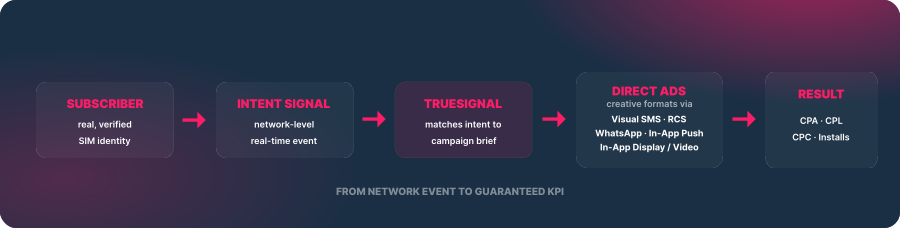
Telco first-party data is one of the only post-cookie targeting foundations that preserves identity-level precision without sacrificing privacy compliance. In-network dynamic IDs offer a 100% match rate within the operator’s subscriber base. The same contractual consent framework that covers voice and data services governs them too. Third, brands that activate telco data now are not simply hedging against future signal loss. They are building a data infrastructure that is durable, compliant, and commercially superior to the programmatic average. Even today, it beats that average on CPA, CPL, conversion rates, and audience verification. The cookieless world is already here for most of your audience. TrueSignal is already the answer.
Privacy-safe does not mean less effective. When identity is contractual and consent is explicit, signal quality is higher — not lower — than anything the open web ever produced.
SOURCES
- ↗ UXCam / enable3.io Mobile App Day-30 Retention Benchmarks 2025 — 4–12% industry average by category
- ↗ AppsFlyer State of App Marketing Report 2025
- ↗ Meta Advantage+ App Campaigns CPI benchmarks
- ↗ Adjust Mobile App Trends Report 2025