
The advertising industry has operated for years on an uncomfortable fiction: that modelled audiences are close enough to real ones. Probabilistic targeting, built from browser cookies, device fingerprints, and inferred behavioral patterns, was never precise. It was simply the best available, until deterministic signals made something better possible. Research from programmatic audits has found that only 18% of users served to a “women 18–24” segment were actually female and between 18 and 24. Audience segments built on probabilistic inference can carry classification errors of up to 80%. Brands do not typically see this figure. They see click-through rates and reach statistics, and they optimize around the noise.
“Deterministic identity is not a targeting upgrade — it is a category shift. You are no longer reaching a modelled approximation of your customer. You are reaching them.”
How Deterministic Signals from Telco Networks Operate
Telco-sourced signals operate on fundamentally different logic. When a subscriber interacts with a mobile network — making a call, topping up a balance, activating roaming, or triggering a data event — that interaction is tied to a contractual, verified identity. The SIM card is registered.
The account is authenticated. There is no inference, no modelling, no cross-device probabilistic matching. TrueSignal draws on these network-layer events to identify subscribers at moments of commercial intent — not because a model suggests they might be interested, but because a real-time event confirms it. The match rate is not 60%. It is not 90%. Identity confidence is effectively 100%, because the data originates from the network relationship itself.
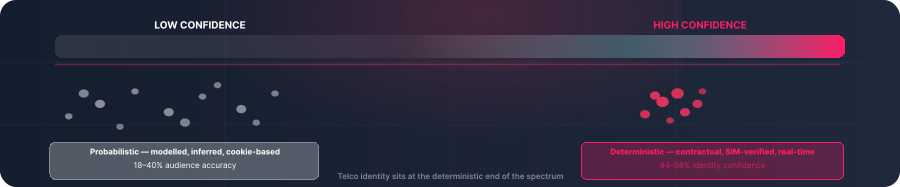
The performance gap between Deterministic and Probabilistic
The performance gap between deterministic and probabilistic approaches is not incremental — it is structural. Because the underlying audience is real and verified rather than statistically estimated, every downstream metric improves. Click-through rates rise because messages reach. people with confirmed relevance. Conversion rates improve because intent is established before the ad is served, not after. Across TrueSignal partner campaigns, brands have consistently recorded CPA reductions of 40–54% versus equivalent programmatic spend — a figure that reflects audience quality, not creative investment. Meanwhile, the IAB estimates that existing signal loss from Safari, Firefox, and iOS App Tracking Transparency has already made 50–60% of internet users effectively untargetable through probabilistic methods, a figure that will only grow as privacy regulation tightens across markets.
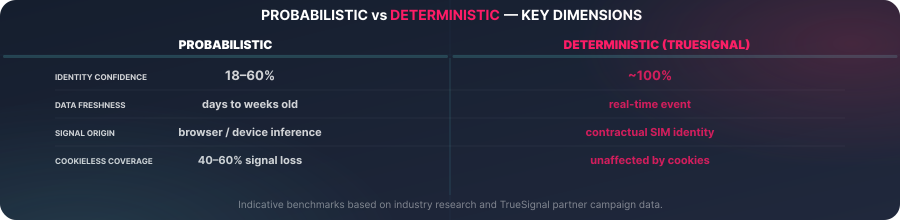
For brands and agencies looking to shift from probabilistic to deterministic targeting, the practical step is to re-examine where audience quality is currently being assumed rather than verified. The question is not whether your current targeting is good enough — it is whether you can afford to keep optimising around inaccuracy as the addressable pool shrinks and privacy regulation raises the floor on acceptable data practice. TrueSignal offers a pathway that does not require trading reach for compliance, or compliance for performance. The telco identity layer is always-on, always-fresh, and structurally immune to the signal erosion that is rewriting programmatic economics.
SOURCES
- ↗ IAB / eMarketer — Signal Loss and Identity Resolution Report, 2024
- ↗ ANA / Forrester — Programmatic Audience Accuracy Studies: Segment Quality in Digital
- Advertising, 2023
- ↗ MRC / IAB — Audience Verification Standards and Viewability Guidelines, 2024