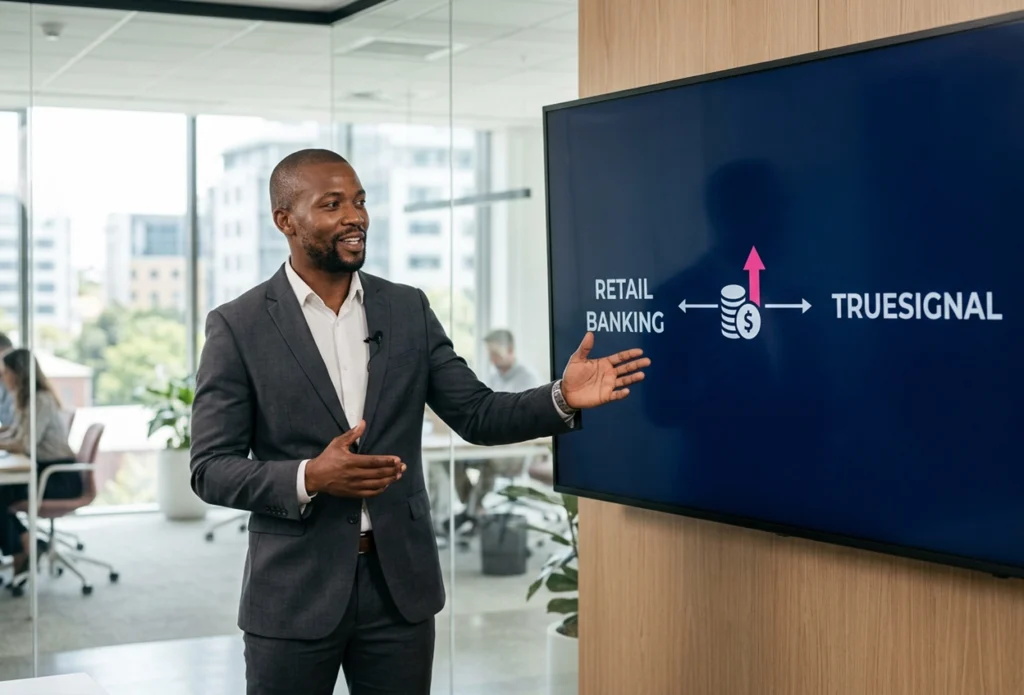
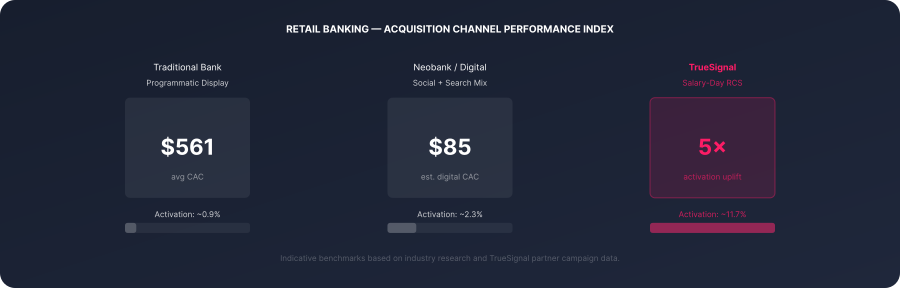
The economics of retail banking customer acquisition have deteriorated sharply. Traditional retail consumer banks now average $561 per acquired customer. Costs have risen 69% since 2019, from $437 to over $743, according to 2025 industry benchmarks. Digital-first challengers have disrupted the top of the funnel with lower-cost performance marketing. But even the most efficient digital bank still confronts a fundamental problem. Financial product consideration is irregular, low-frequency, and almost entirely context-dependent.
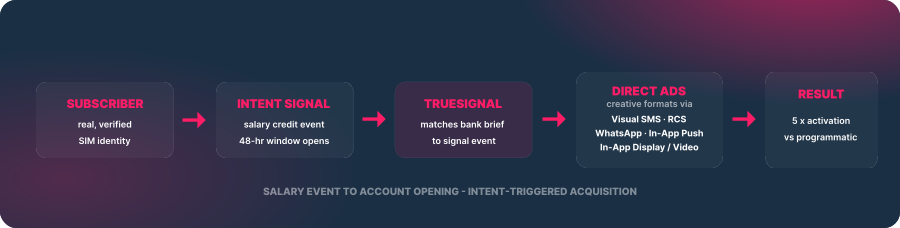
A person is not thinking about a new savings account most of the time. They are, however, highly receptive to a compelling savings offer in the 24 to 48 hours after their salary lands. That window is real, narrow, and largely invisible to marketers using cookie-based or panel-derived targeting. TrueSignal makes it visible.
There is a predictable moment each month when a subscriber’s financial disposable intent peaks. It opens on salary day and closes within 48 hours. Miss it and you wait another month.
How the Salary-Day Signal Works
TrueSignal identifies income credit event patterns through network-level signals. Specifically, it reads the device behaviour and usage patterns that reliably correspond to a salary credit event. The signal is derived entirely from network usage data and service activation events. It has no access to financial records, banking data, or any message content.
The signal is privacy-safe by design. No financial data is accessed, no banking records are read, and all activation is consent-based within the MNO relationship. What TrueSignal delivers to the brand is a trigger: this subscriber has just entered their monthly peak intent window. An RCS message fires into that window. It displays a personalised savings rate, a one-tap account opening flow, and a clear value proposition.
It reaches a consumer who is, at that precise moment, unusually receptive toward financial decisions. The offer is not an interruption. It arrives at the exact psychological moment the consumer is already thinking about money.
Why Timing Beats Always-On in Retail Banking
Results from a 2025 campaign with a Southeast Asian challenger bank are clear. Run through a TrueSignal MNO partner, it showed account activation rates 5 times higher than equivalent-budget programmatic display at the same CPA target. The compliance credentials matter just as much in regulated financial services.
TrueSignal’s activation relies entirely on the subscriber’s existing consent relationship with their MNO. Financial data is never accessed or inferred, and all campaigns operate within GDPR-aligned and local data protection frameworks. For banks navigating both performance pressure and regulatory scrutiny, that combination is powerful.
Deterministic timing, verified audience, privacy-safe mechanics, and measurable CPA reduction represent a structural advantage. It beats the probabilistic targeting that dominates digital banking acquisition today.
The 48-Hour Window as the Start of a Relationship
The compounding advantage for financial services brands is product breadth. A subscriber who opens a savings account through a salary-day RCS campaign is not just an acquired customer. They are a high-intent financial services consumer at a moment of active engagement with their finances. That initial product relationship, built on a well-timed offer, creates the foundation for cross-sell: insurance, lending, investment products.
The 48-hour window is not just an acquisition channel. It is the beginning of a customer relationship, established at the one moment each month when financial decisions feel natural to make. For banks competing in markets where acquisition costs have risen by over two-thirds in six years, that precision is not a marginal gain. It is a structural competitive advantage.
SOURCES
- ↗ FirstPageSage / VisaBanking Retail Bank Customer Acquisition Cost research 2025
- ↗ Fintech Magazine digital banking customer acquisition trends
- ↗ Sinch / Vonage financial services messaging conversion research
- ↗ GSMA Mobile Money and Financial Services report