
Streaming churn is one of the most costly problems in entertainment media, and every lapsed subscriber starts leaking value weeks before they cancel. Monthly churn rates across major platforms climbed from 2% in 2019 to 5.5% by early 2025. Now 23% of the US streaming audience qualifies as serial churners, cancelling three or more services within two years. The standard industry response is reactive. When a subscriber cancels, a win-back email sequence fires. But cancellation is already the outcome of a multi-week disengagement process. Most platforms have no way to observe it in real time.
By the time the cancel confirmation is logged, the subscriber has already moved on emotionally. The actionable intervention point is not the cancellation event. It is the disengagement pattern that precedes it by two to four weeks. That pattern is visible in the network data long before it surfaces in platform analytics.
A subscriber who watched 4 hours of video daily for six months and drops to near-zero in week nine is not experimenting. They are lapsing. The question is whether you catch it before or after they hit cancel.
Reading the Lapsed Subscriber in the Network Data
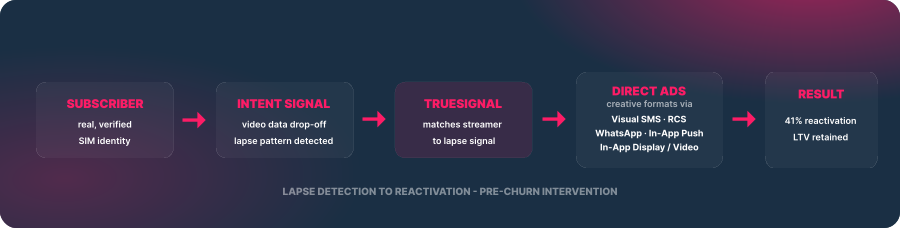
TrueSignal identifies video streaming disengagement through network-level data consumption analysis. Consider a subscriber whose mobile data shows sustained high-volume video use over weeks, consistent with daily streaming. Then it drops sharply over a 7 to 10 day period. That is a disengagement signature. This is not an inference or a model output. It is a direct observation of changed network behaviour at the SIM level. When that drop-off pattern triggers, TrueSignal fires a re-engagement campaign before the subscriber formally cancels.
The RCS message delivers a personalised content recommendation, matched to the subscriber’s likely genre based on viewing pattern proxies. It carries a prominent new-release hook and a one-tap deep link into the platform. The message lands when the subscriber has lapsed but has not yet cancelled. That is the only window where re-engagement is possible without the friction and LTV loss of a full churn event.
The Reactivation Gap at the Point of Lapse
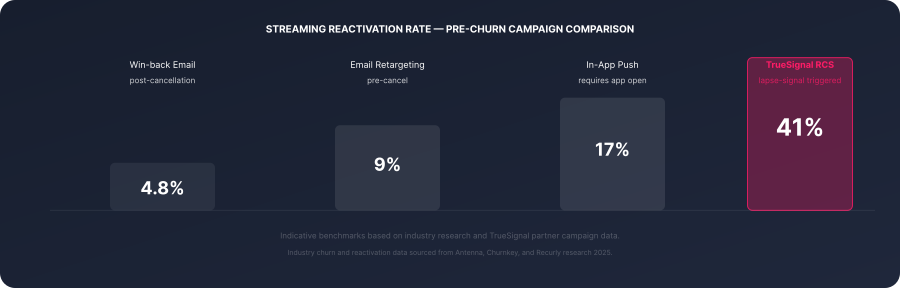
Results from a 2025 campaign are clear. Run across a TrueSignal MNO partner serving a major streaming platform, the pre-churn RCS campaign achieved a 41% reactivation rate. Reactivation is defined as a subscriber returning to active streaming within 7 days of the message. The equivalent email retargeting campaign, fired to the same cohort, produced just 9%. The LTV implication of that 32-point gap is significant. Average streaming subscriber LTV is estimated at $140 to $220 per year.
So retaining even one subscriber for two extra months at the point of lapse funds the entire campaign. Intervening at the pre-cancel stage is not a retention tactic. It is LTV compounding at the most economically efficient point in the subscriber lifecycle. For platforms where monthly churn has nearly tripled since 2019, catching the lapse before the cancel is not optional. It is the most important capability they can build.
Building an Always-On Retention Loop
The broader strategic implication extends beyond individual campaigns. Streaming platforms can integrate TrueSignal’s lapse-detection into their subscriber health monitoring. This creates a continuous, always-on retention loop. Subscribers showing early disengagement signals are automatically entered into a re-engagement workflow before they reach the cancellation threshold. Over a 12-month period, this systematic intervention compounds significantly.
A platform with 2 million subscribers and a 5.5% monthly churn rate recovers 36,000 to 50,000 additional subscriber-months per year. That comes from pre-cancel intervention versus post-cancel win-back. At an average LTV of $180 per year, that represents $5 to $9 million in retained annual revenue from a single capability upgrade. The data consumption pattern was always there. TrueSignal makes it actionable.
SOURCES
- ↗ Antenna / Churnkey “Streaming Churn Rate” study 2025 — monthly churn up to 5.5%, 23%
- serial churners
- ↗ Parks Associates OTT subscriber retention research
- ↗ Sailthru / Klaviyo re-engagement campaign benchmarks
- ↗ Digital TV Research global streaming subscriber report