
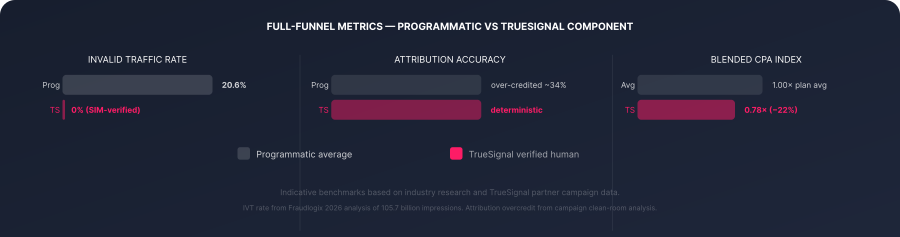
Ad fraud is not a line item that agencies discuss openly with clients. But its compounding effect on campaign performance is significant and structurally under-reported. In truth, reaching a verified human at every stage is harder than it sounds. Analysis of 105.7 billion impressions across 2025 found a global invalid traffic (IVT) rate of 20.64%. Roughly one in five programmatic impressions showed characteristics of fraudulent or non-human activity.
Across social platforms, analysts estimate click-fraud rates between 57% and 74% on certain networks. However, the effect on the full funnel is not simply that 20% of impressions are wasted. In fact, the damage compounds. For example, an awareness campaign that reaches bots in significant numbers inflates reach metrics, creating false confidence in scale. Those fraudulent interactions then feed into lookalike audience models, contaminating the targeting for the next funnel stage.
And when attribution models try to credit touchpoints on the path to conversion, bot-inflated exposure data distorts the model. It directs future budget toward channels that only appear to perform, because bots generate the signals that performance metrics reward. Fraud at awareness does not stay in awareness. It degrades everything downstream.
When the audience is structurally contaminated, no amount of creative optimisation or bidding strategy can fix the downstream CPA. The problem is not the campaign. It is the foundation it is built on.
Why a Verified Human Audience Is Structural, Not a Filter
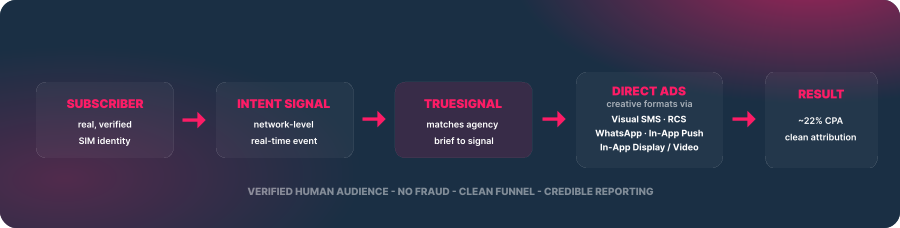
TrueSignal’s structural guarantee is different in kind from any fraud-detection or brand-safety overlay applied to programmatic inventory. Indeed, every subscriber in a TrueSignal campaign is SIM-verified, a real contracted person on a real mobile network. As a result, there is no intermediary layer between the MNO subscriber database and the campaign delivery. No exchange, no DSP, no resold inventory, no unknown supply chain segment. Crucially, the audience verification is not a filter you apply after the fact. Instead, it is the foundation of the delivery architecture.
At every stage of the funnel, awareness, consideration, conversion, every impression lands on a verified human who gave consent through their network relationship. Therefore, for agencies, this eliminates the compounding fraud problem at source. Rather than manage it through increasingly sophisticated post-delivery measurement, it removes the problem entirely.
Clean awareness produces clean lookalikes. Clean consideration produces uncorrupted attribution. Clean conversion data produces reliable media mix models that credit what actually works.
What a Verified Human Anchor Did to Attribution
In a 2025 mixed-media plan by a Southeast Asian performance agency for a major FMCG client, the agency introduced TrueSignal as a verified-human anchor. It ran alongside existing programmatic, social, and search activity. Specifically, the TrueSignal component ran at 18% of total media budget. Yet it accounted for 31% of verified conversions, with a CPA 22% below the blended plan average. Notably, the attribution model, run against the clean TrueSignal data, revealed something important.
The programmatic display component had been over-credited in prior reporting by an estimated 34%. Bot interactions had inflated its apparent touchpoint contribution. The reallocation that followed shifted 12% of programmatic budget to TrueSignal. It improved overall CPA by 17% with no increase in total spend. The value of TrueSignal to an agency is not just the performance of its placements in isolation. It is the corrective clarity it brings to the attribution model for the entire plan. Clean data anchors clean decisions.
The Agency Case for a Verified Human Product
The business case extends beyond individual campaign performance. Indeed, it reaches into client relationship and commercial differentiation. Increasingly, clients question the value of reach metrics and demand outcome accountability. In that environment, presenting a certified-human component matters. Specifically, it carries SIM-level verification, consent-based delivery, and attribution untainted by IVT. As a result, this gives agencies a credible, defensible response to the fraud conversation. Moreover, it positions the agency as a proactive quality steward, not a passive channel aggregator.
Agencies that build TrueSignal into their standard planning toolkit are not simply improving CPA on individual line items. They are building a structural quality advantage that elevates every performance claim they make. In a market where 20.64% of programmatic impressions are invalid, guaranteeing 100% human reach is not a marginal upgrade. It is a different product entirely.
SOURCES
- ↗ Fraudlogix 2026 Global Invalid Traffic Report — 20.64% IVT across 105.7 billion impressions
- ↗ ANA Programmatic Transparency Report — intermediary fees and supply chain analysis
- ↗ Nielsen / Kantar marketing mix modelling and attribution research 2025
- ↗ IAB / ARF Clean Room and Attribution Standards documentation
- ↗ GroupM “This Year Next Year” global media investment report 2026