
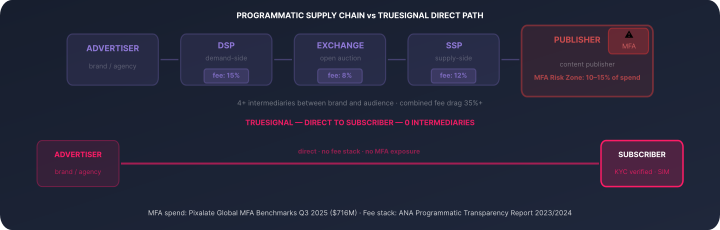
Made-for-Advertising sites are one of the more dispiriting structural features of the open programmatic web, and a direct threat to brand safety. They are not publishers in any editorial sense. Instead, these are content farms engineered to satisfy the minimum requirements of inventory accreditation. No brand would deliberately choose to reach the audience they serve. Pages are stuffed with repackaged content, surrounded by ad slots at densities that preclude genuine reading. They generate traffic through incentivised click networks and bot activity.
In Q2 2025, Pixalate estimated that $770 million in global programmatic spend landed on MFA publishers in a single quarter. This happened even as the industry’s blocklist efforts began to reduce MFA exposure. The 2023 ANA study had found 15% of open exchange impressions flowing to MFA inventory. The problem is smaller than it was. It has not been solved.
Verification tags are retrospective instruments. They tell you where your money went. They do not stop it from going there in the first place.
The Reputation Cost of MFA Exposure
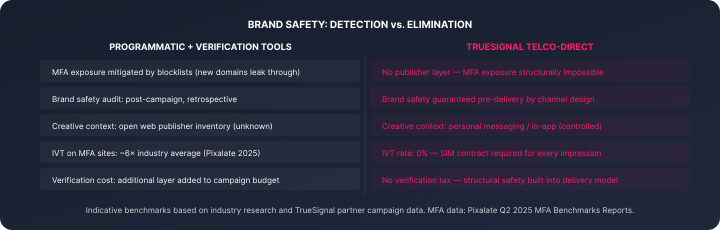
The structural limitation of brand safety tools, like IAS, DoubleVerify, and their equivalents, is that they operate after the bid. Pre-bid targeting lists and contextual filters reduce MFA exposure. But they depend on those sites being correctly classified and blocked in your DSP configuration. New MFA domains emerge continuously. Classification lags. Open exchange inventory, by definition, includes publishers not vetted by any direct relationship. The retrospective audit function of post-campaign reporting tells a brand’s media team where their creative appeared. By then, the spend has already occurred.
The reputational risk has already materialised. A luxury brand whose creative ran alongside low-quality clickbait cannot un-run it. They can only note it, flag it, and try to configure their way around a similar outcome next time. This is an inherently reactive posture in a system that generates the problem continuously.
Brand Safety: Detection vs. Elimination
MFA exposure is not just a media efficiency problem. It carries a brand reputation dimension that is harder to quantify but more consequential. A premium brand appearing at high frequency alongside low-quality content trains a negative association in the consumers who notice it. The brand registers as part of an environment, not just an advertisement within it. Verification tools provide post-campaign audit data showing where impressions ran. They do not undo the brand environment in which those impressions appeared. For CMOs managing brand equity alongside performance KPIs, the more durable solution is not to invest more heavily in verification tooling. It is to route a greater share of budget through channels where the concept of an MFA publisher cannot exist. TrueSignal’s model has no publisher layer.
Creative is delivered directly to a subscriber’s device through MNO infrastructure, in SMS, RCS, WhatsApp, push notification, or in-app format. There is no third-party web inventory, no exchange-sourced placement, no publisher context to audit.
Brand Safety by Design, Not by Audit
The practical recommendation for brand and agency media teams is to distinguish between two things. There is brand safety as a detection discipline, and brand safety as a channel selection decision. Verification tools are valuable for auditing programmatic spend. But they are not a substitute for asking whether a channel is structurally safe by design. Telco-direct messaging channels have no inventory marketplace, no open exchange, and no publisher whose content quality must be monitored. These include SMS, RCS, WhatsApp, and in-app formats delivered through MNO infrastructure.
The creative arrives in a controlled, personal context. The audience is verified. The placement is not subject to programmatic supply chain risk. For brands where context is a brand asset, such as luxury, financial services, healthcare, and premium consumer goods, the case for telco-direct channels is not just a performance argument. It is a brand architecture argument.
SOURCES
- ↗ ANA (Association of National Advertisers) — Programmatic Transparency Report 2023/2024: 15% of open exchange impressions flowing to MFA inventory (2023 peak); subsequent reduction through blocklist efforts
- ↗ Pixalate — Global MFA Benchmarks Q3 2025: $716 million in MFA spend per quarter globally; MFA IVT rates ~6× non-MFA inventory average
- ↗ Verve — “How MFA Sites Hurt Brands” 2025: brand safety and reputational risk dimensions of MFA exposure for premium advertisers
- ↗ eMarketer — “5 Key Stats on Ad Waste: Fraud, MFAs, Brand Risks” 2025: Q2 2025 MFA spend estimated at $770 million globally
- ↗ ExchangeWire — “Navigating Brand Safety in 2025”: supply path optimisation outcomes and structural brand safety approaches