
Conversational Commerce at Scale: How RCS Turns a Notification into a Transaction
The purchase funnel was designed for a desktop era. A consumer sees an ad, clicks to a website, browses, adds to cart, enters details, and checks out. Six discrete steps, each one an opportunity to lose them. Conversational commerce exists to close that gap. Across retail, average cart abandonment rates sit above 70%. That means for every ten shoppers who show intent, seven leave before they buy. The funnel itself is the problem. Every step is a friction point, and friction compounds. The solution is not to optimise each step. It is to eliminate them.
RCS does not improve the journey. It replaces it: message received, product seen, purchase made, thread closed.
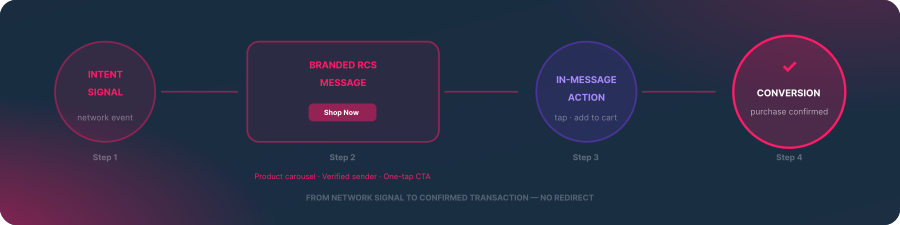
How RCS Collapses the Funnel Into One Message
Rich Communication Services (RCS) fundamentally changes what a business message can do. Where SMS delivers text, RCS delivers a branded, verified experience. It is a rich card with a product image, a title, short copy, and two tappable CTAs. Below that sits a scrollable carousel of product thumbnails. The entire catalogue is inside the message. The carrier verifies the brand sender, with a logo and a checkmark that cannot be spoofed. No link to click, no site to load, no cart to find. Research from messaging platforms shows RCS rich cards drive 60 to 70% higher conversion rates versus MMS.
Click-through rates run 3 to 7 times those of standard SMS. WhatsApp commerce data reinforces the picture. Cart abandonment recovery via rich messaging achieves up to 25% conversion on otherwise lost baskets. Email recovery sequences reach just 5% on equivalent audiences.
For retail, travel, and QSR brands, the implications are material. Fewer steps means fewer drop-offs, and fewer drop-offs means a structurally lower cost per transaction.
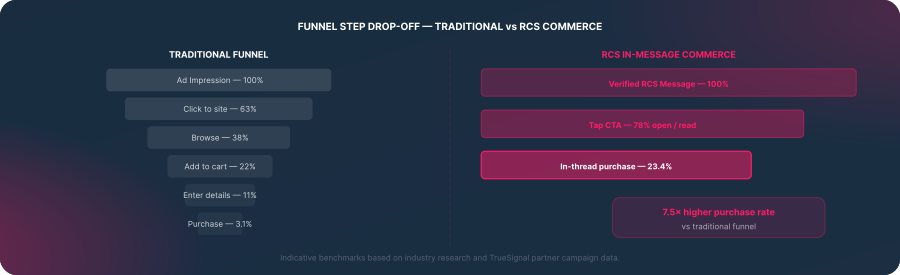
Turning Intent Signals Into Conversational Commerce
The brief for commerce teams changes accordingly. This is not a question of which format to run. It is a question of which audiences should receive a commerce-enabled message, and when. TrueSignal’s network signals are derived from device activation events, roaming triggers, top-up behaviour, and app-category traffic.
They surface the moment of purchase readiness before a consumer reaches any brand touchpoint. Combined with RCS delivery, that moment becomes an immediate transaction opportunity. It is no longer the start of a six-step acquisition funnel. Retail brands using intent-targeted RCS in TrueSignal partner markets are measuring real cost-per-transaction reductions. At scale, those reductions make the entire model self-funding.
The question for your commerce team is not whether to test it. It is what your current funnel abandonment is costing you, month by month.
SOURCES
- ↗ Zixflow / Kanal WhatsApp cart recovery conversion research 2025
- ↗ Sinch / MessageFlow RCS conversion rate benchmarks
- ↗ nativeMsg “RCS vs Email Marketing 2026”
- ↗ Juniper Research RCS Business Messaging market report
- ↗ Attentive “SMS, Email, Push and RCS Orchestration” research