
From Broadcast to Precision: Personalised Messaging at Network Scale
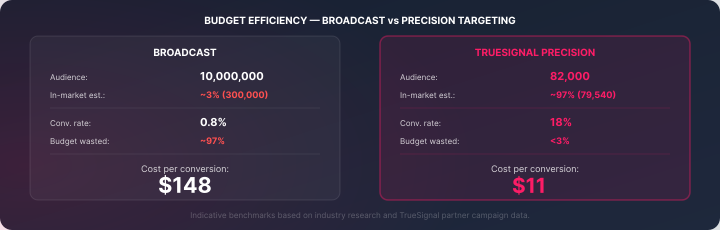
The broadcast brief has a structural ceiling, and personalised messaging has mostly failed to break it. Deploy a message to 10 million people, accept that most are not in-market, and work backward from a 0.8% conversion rate as if it were immutable. The optimisation happens at the margins. You A/B test the headline, adjust the bid, tweak the audience age range. But the fundamental problem remains: most of the budget goes to people who are not ready to buy. Personalisation, as practiced in digital advertising, applies a thin layer of dynamic content on top of a broadcast targeting model.
Changing the hero image by segment does not change the fact that the audience remains broadly defined. Research from McKinsey and multiple ad-tech studies finds that companies with mature personalisation generate 40% more revenue from marketing spend. Yet studies clearly document the ceiling on what demographic or interest-based personalisation can achieve.
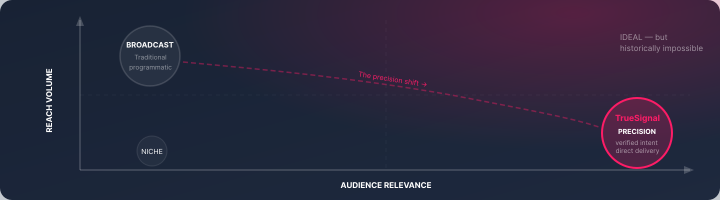
The shift is not from broad to narrow targeting. It is from demographic filtering to behavioural moment selection.
Why Personalised Messaging Starts With the Signal
TrueSignal’s targeting model operates differently because the underlying data is different. The network does not model intent. It observes it. A subscriber who hits a data threshold, enters a salary-credit cycle, activates a new SIM, or reaches a device-upgrade window is not inferred to be in a commercial mindset. The event itself is the signal. This lets campaigns be built around verified behavioural moments matched to category relevance, not demographic profiles. The number reached is smaller. It is not 10 million, but 82,000 verified, in-market people.
The message is calibrated to the specific moment that triggered selection. Research consistently shows that 72% of consumers exclusively engage with personalised messaging. Personalised calls-to-action outperform generic ones by 202%. At TrueSignal, personalisation does not sit on top of targeting. It is the targeting. The signal that selects the audience is the same signal that informs the message.
Rewriting the Agency Brief for Precision
The implication for agency briefs is structural. The traditional ask, reach as many people as possible in the target demographic, needs to change. The more precise brief is this: reach verified, in-market people at the moment of highest readiness, with a message calibrated to that moment. The volume number looks smaller. The conversion and cost-per-result numbers look dramatically better. Personalisation research shows customer acquisition costs can fall by as much as 50% when relevance replaces volume as the primary targeting variable.
For brands running broad programmatic at high volume and optimising for post-campaign efficiency, the conversation is straightforward. What does your current cost per verified, quality conversion actually look like? And what would you pay to cut it by half?
SOURCES
- ↗ McKinsey “The Value of Getting Personalisation Right” 2025
- ↗ Instapage personalisation conversion lift research
- ↗ Salesforce State of Marketing personalisation data 2025
- ↗ Think with Google intent-based targeting performance research