
Most advertising targeting is built on behavioural signals collected from the open web: pages visited, searches performed, products viewed. These signals are useful, but they suffer from a fundamental limitation. They only appear after intent has already formed. By the time a user has searched for a product, they have already completed the interest and consideration stages of the purchase journey. The open web sees the expression of intent. What it never sees is the conditions that create it. Inside the mobile network, those pre-intent signals are visible in real time. They tell a richer story about commercial intent than any browsing pattern can.
“Network-layer signals reveal commercial readiness before the consumer has expressed it anywhere — before the search, before the browse, before the click.”
The Intent Event
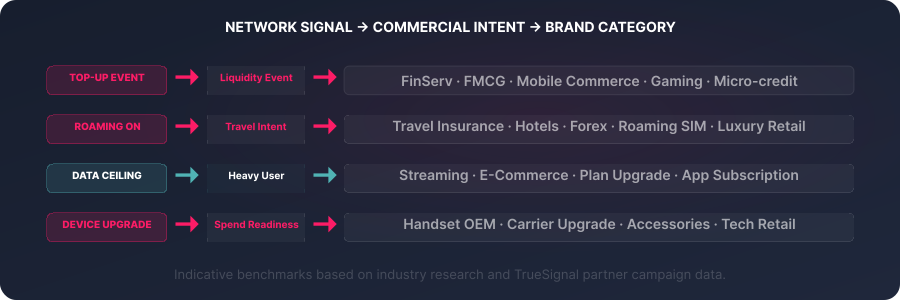
Consider what a top-up event actually represents. A prepaid subscriber adding credit to their account is performing a liquidity event. They have discretionary spend available and are actively managing it. For brands in financial services, FMCG, mobile commerce, or gaming, this is one of the highest-value purchase-intent signals in the ecosystem. A roaming activation is equally rich. It signals imminent international travel, unlocking opportunities in travel insurance, forex, hotel booking, SIM upgrades, and luxury retail. A subscriber hitting their data ceiling is a confirmed heavy digital user, a premium audience for streaming, e-commerce, and app-based services. A device upgrade cycle entering its 18–24 month window identifies a subscriber likely to be evaluating handset purchases within 60–90 days. None of these signals are available in any open-web data set. They are structurally invisible to platforms that rely on browser or app data.
Network Signal – Commercial Intent – Brand Category
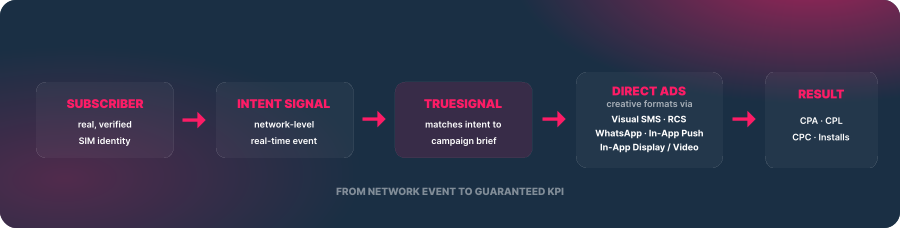
What makes this commercially significant is not just the signal itself, but its temporal precision. Search intent signals are captured at the moment a user types a query. Network signals, by contrast, are captured when a real-world condition changes: when the top-up happens, when the border is crossed, when the data threshold is hit. TrueSignal synthesises these events in real time and matches them to campaign briefs within seconds. This lets brands reach subscribers during windows of peak commercial receptivity that typically last hours, not days. A salary credit arriving on the 25th of the month creates a 24–48 hour liquidity window. A roaming activation creates a 72-hour travel preparation window. These are not audience segments that can be refreshed weekly. They are moments that expire.
For brands and agencies looking to brief against network signals, the planning shift is modest but consequential. Rather than defining audiences by demographic or interest category, briefs should be structured around signal type and activation window. Which subscriber behaviour reveals the most relevant purchase intent for this product category? And how quickly must a message reach that subscriber before the window closes? TrueSignal’s planning team maps each campaign brief to the most predictive signal type within each MNO partner network. This ensures that budgets activate precisely where commercial intent is already present, not where it is merely probable. This is not targeting as filtering. It is targeting as listening.
SOURCES
↗ Exacaster — “How Telco Data Shapes Targeting in Finance, Retail, and Travel”, 2023
↗ Novatiq — Telco Data Monetisation and First-Party Identity Studies, 2023–2024
↗ Adsquare — “3 Reasons to Use Telco Data in Campaign Planning”, 2023
↗ Mobile Marketing Association (MMA) — Intent Data Research: Network Signals and Purchase Readiness, 2024